Total Pageviews

Tuesday, May 29, 2012

Meter

Meter
Definition: A pattern of stressed and unstressed syllables in a line of poetry. Lengths of meters can vary; the name of a meter depends on how many feet it consists of. (Monometer-one foot, dimeter-two feet, etc.)

Example:
 
Iambic Pentameter
From "On His Blindness," by John Milton
      1.............2............. 3...............4..............5
When I..|..con SID..|..er HOW..|..my LIFE..|..is SPENT
       1.................2.............. 3..................4...................4
Ere HALF..|..my DAYS..|..in THIS..|..dark WORLD..|..and WIDE
Significance: Meters provide a poem with rhythm. Therefore, as stated before, a poem can flow and have a nice beat when you read or recite it.

Picture:
"A poem's meter is its heartbeat."
 

Rhyme

Rhyme
Definition: The repetition of certain sounds in the same position of a poem, usually at the end of a line.
Example:
Time
The question that is asked the most; we hear it everyday,
“What time Is it?” they want to know, and then they go away.
It's time for bed, it's time for work, or time to feed the fishes,

It's time to take your medicine, or wash and dry the dishes.
Time in seconds, time in hours, so many freckles past a hair,
depending on the zone, or whether daylights savings there.
Time is measured many ways from minutes to months,
Time is what keeps everything from happening at once!

A time to live, a time to die, a time for having fun,
Clocks and calenders alike, all scheduled by the sun.
Intervals that cant be hurried, will not be denied,
a season that we know that's coming, as surely as the tide.

If there ever comes a time when time will be no more,
I wonder how we'll know to quit, or when it was before.
Do we hurry? Do we loaf? It depends upon the time...
Had we started earlier, we'd be finished with this rhyme.
 
by: Erin Friedrichs
 
Significance: Like rhythm, rhymes give poems a flowing, controlled feel. It is also a form of repetition; the repetition of sounds. Rhymes can give poems rhythm.
 
Picture:

Rhythm

Rhythm
Definition: The patterns of sounds or way of reciting a poem created by stressed and unstressed syllables in lines and stanzas of poetry.
  
Example: This is Christopher Marlowe's line from Dr. Faustus, including the stressed and unstressed syllables.
"Was this the face that launched a thousand ships"
Duh-DUH-duh-DUH-duh-DUH-duh-DUH-duh-DUH
Significance: When writing and reading poetry, it is supposed to flow and have patterns. Rhythm helps to create those patterns and can give a nice beat to the poem. It can be thought of as a form of repetition, which can emphasize important parts of the poem.

Picture: 


Thursday, May 24, 2012

Onomatopoeia

Onomatopoeia
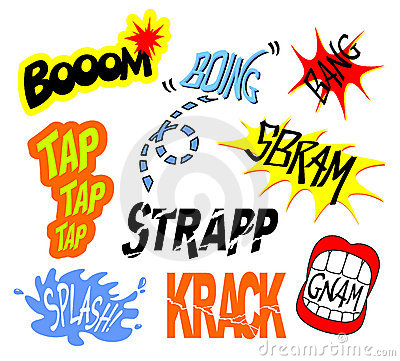
Definition: Words incorporated into a literary piece by imitating the sounds they are supposed to describe.

Example: In comic books, the authors will use BAM! and POW! in their story to emphasize fights.

Significance: Using sounds can also you feel like your're part of a story because you can hear it and sometimes see it. I think of it as a form of imagery.

Picture:

Imagery

Imagery
Definition: Parts of a literary piece that use the senses to help the reader make the poem feel more real; they can feel like they're a part of it. The types are: Auditory (hearing), Visual (signt), Tactile (ouch), Gustatory (aste), Olfactory (smell), Organic (internal feelings such as anger and joy), and kinesthetic (movement that you can sense).

Example: In the poem, "Alabanza," it created visual imagery because I could see the workplace, but also organic because I felt the mourning feeling for the lost lives.

Significance: Imagery helps you create a scene in your head while you're reading so you can better understand the author's meaning. It can help you feel like you're part of whatever is described.

Picture:

Personification

Personification
Definition: Giving a non-human human abilities and qualities. It does not necessarily have to be an inanimate object; personification can be applied to animals.

Example: In most childrens' cartoons, there will be animals that can talk and do other things usually only capable by humans. For example, Spongebob and Toy Story.

Significance: Personification is important because it can be applied to any literary piece in various ways. It is easy to use and can make a boring story an exciting fantasy.

Picture:

Simile

Simile
Definition: Comparing two unlike things using the words like or as.

Example: Yesterday I was as busy as a bee.

Significance: Similes can make reading things more excitable and easier to understand. Similies can be fun, even though it may sometimes be hard to find the exact meaning. Simpler similes can be put into childrens' writing to make it humorous to write or illustrate.

Picture:

Friday, May 18, 2012

Repetition

Repetition
Definition: Using the same phrase or word over and over again; usually in the same position of a stanza in poetry.

Example: In the poem "If" the word 'if' is repeated, and more specifically, the phrase 'If you can.'

Significance: Repetition can cause a sense of rhythm or importance in the phrase. It can almost be comforting to some because they hear the same, obviously significant phrase multiple times.

Picture:


Tone

Tone
Definition: The way or attitude in which something is told; it will usually have to do with emotions. Poems can have multiple tones.

Example: In the poem "If," the tone at the end is rejoiceful and celebratory because the speaker is celebrating becoming a man.

 
Significance: The tone of a literary piece can affect your interpretation of it. The tone can influence your mood in the real world or can make you write in that certain tone.

Picture:


Interpretation

Interpretation
Definition: The way one takes, sees, or percieves a piece of literature. For example, this can apply to finding the theme of a poem or story; everyone can see it differently.

Example: (The last line of "If")
"And-- which is more-- you'll be a Man, my son!"
This can be taken as misogynistic, which means he only belives in the male gender. He could also be referring to all of mankind.

Significance: This absolutely relates to any way you communicate in life. Everyone has a different interpretation of something. When you have your own opinion on the way you percieve something and see the ways others do, you can expand your mind to more ideas. 

Picture:


Wednesday, May 16, 2012

Metaphor/Extended Metaphor

Metaphor/Extended Metaphor
Definition: A metaphor is a poetic or literary device that compares two unlike things without using the words 'like' or 'as.' An extended metaphor is many metaphors branching off one main concept or comparison.

Example: Life is a journey. Our bodies are the cars. Our accomplishments are the mesmerizing sights we see along the way. Our purposes are the places we want to get to; the destinations. Our friends are a part of the caravan accompanying us on the long, elaborate journey of life.

Significance: Metaphors are important because they can help us see what the poet or author is trying to describe, and it's more interesting than just regular words. We use metaphors every day in language without even realizing it. Metaphors can also be humorous, which can make a piece of literary art exciting and enjoyable to read.

Picture:


Monday, May 14, 2012

Speaker

Speaker

Definition: The person in which the point of view of the piece of poetry is being told. The speaker is not necessarily the author of the poem. 

Example:

I'm Nobody! Who Are You?

by Emily Dickinson.

I'm nobody! Who are you?
Are you nobody, too?
Then there's a pair of us - don't tell!
They'd advertise - you know!
How dreary to be somebody!
How public like a frog
To tell one's name the livelong day
To an admiring bog!

The speaker of this poem is probably someone insecure and feels like they're not worth much. It could possibly be the poet.

Significance: When you have different speakers, poets get the chance to express their views in different perspectives. They can be one person in one poem, then a completely different one in another.

Picture:


Thursday, May 10, 2012

Symbol

Symbol

Definition: a word, phrase, or item in a lietrary piece that stands for something more than what is obvious.

Example: When we read The Pearl  Kino's knife wasn't just a weapon, it represented bravery and the need to protect his family.


Significance: Symbols are important because they can tell a story through something simple, and it                                                                     can trigger feelings and inner thoughts.

Picture:


Couplet

Couplet

Definition: 2 lines in a piece of poetry that are usually the same length, and somethimes rhyme. In other words, a couplet is a 2-line stanza.

Example:

Sudden Baldness"Oh my!" the portly gent called out. "I cannot find my hair.
I washed and put it out to dry, and now it isn't there!"


by Denise Rodgers

(This is a one couplet poem.)


Significance: Couplets are importan because they shorten stanzas into short, easy to read ideas. If they rhyme, it can be humorous, which can make poetry more fun.

Picture:


Stanza

Stanza

Definition: a group of lines in a piece of poetry put together because they are meant to bea read as one connected idea.

Example:
"What's the big deal?
It's not even real
You may have that feeling
Like your walking on the ceiling

can you look me in the eyes
and tell me your lies
you've said it to every other girl
it makes me want to hurl

one day i'll find the one
he's somewhere over the rising sun
don't waste your time
giving me those silly little rhymes

will it happen today, tomorrow, or next week
the love for you is what I seek
i've said everything I need, i'm done
even though i'm still looking for the one"
~Hannah Horst

(This is an example of a 4-stanza poem.)

Significance: Stanzas are important because they organize ideas into groups of lines that can make a poem easier to comprehend. They are the paragraphs of poetry.

Picture:

Thursday, April 26, 2012

Poetry


A visual topography of poetry by Ebon Heath.


Definition: A distinct and creative way to express one's self in a rhythmic body of literature. It can either be written or spoken; either way will inform the reader of the poet's feelings or thoughts.

Example: This is one of the most famous haikus, a type of poetry. It is by Basho.

"old pond . . .
a frog leaps in
water’s sound"
Significance: I think poems are important because they have deeper meaning than any type of book. You can express your emotions in a creative way in many different forms.